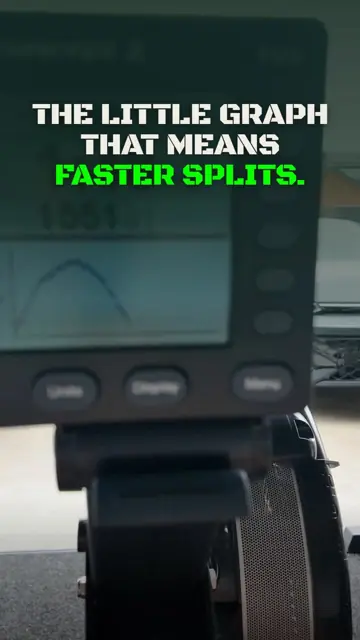
Every erg you get on in a public gym, or down at Rowing New Zealand, has had a bit of abuse thrown at it. That's why the number on the side of the fan cage can't be trusted, and why I always check one number before I start.
What is drag factor on a rowing machine?
Drag factor is the number that tells you how heavy the erg feels. Concept2 explains it like this: between strokes, the monitor measures how fast the flywheel is slowing down, and that rate is the drag factor. The monitor then uses it to work out how much work you're doing, so your score is fair whatever the damper is set to.
In practice it's the feel of the boat. A high drag factor feels like a slow, heavy boat. A low one feels light and quick.
What does the damper do on a rowing machine?
The damper is the lever on the side of the fan cage, numbered 1 to 10. It controls how much air gets into the flywheel housing. More air means more work to spin the wheel and a heavier feel. Concept2 compares it to gears on a bike: it changes how the stroke feels, not how hard the workout is. You make it hard by pulling hard.
The catch is that the same damper number gives a different drag factor on every machine.
"At a public gym you have to go up to like seven or eight because it's caked in dust. A brand new erg, you're at four."
Dust in the fan, the temperature, even the room can shift it. On another day on that same new erg the drag factor felt a bit high, so I checked it. It was sitting at 134, and I reckon the difference was the garage door being open.
So don't set the damper by number and go. Read the drag factor off the monitor, then move the lever until you're where you want to be. On a Concept2 the monitor has a screen that shows it.
What is the best drag factor for rowing?
"For a heavyweight male your drag factor should generally be at 125 or 130. That was our kind of standard drag factor based on how it feels in the boat."
That's what we used in the Kiwi eight. For women, I find 110 is spot on.
The reason is the boat. I always find that 125 to 130 on the erg, for a man, is close to a crew boat.
"Feels like the weight of like a men's four, like a coxless four, that kind of similar type weight."
A bigger, quicker boat feels lighter again. An eight feels more like a drag factor of 120 to 125.
If you're a big, powerful rower, it's tempting to crank it up so you can feel your strength on every stroke. That's the wrong lesson. The boat doesn't feel like damper 10, so your normal training shouldn't either.
What is the best drag factor for 2k?
Other people land in about the same place. Rowing Australia's protocol for its 2000m and 5000m erg tests sets the drag factor by category: 130 for heavyweight men, 125 for junior and lightweight men, 110 for heavyweight women and 100 for junior and lightweight women. The Malta Rowing Federation recommends a little heavier for testing: 135 for open men, 125 for lightweight and junior men, 120 for open women and 110 for lightweight and junior women.
If your club or federation sets a drag factor for testing, use theirs, so your score lines up with everyone else's. Otherwise I'd test at the setting you train on, the one that feels like the boat. Test day isn't the day to try something new.
When should you use damper 10 or damper 1?
There are times to move well off your normal setting on purpose.
"sometimes it's good to adjust the drag factor as a skill practise, like dropping the drag all the way down to 1 and trying to get the legs really firing, getting used to that fast twitch"
Before racing you can go a step further and cover the fan, to get that fast twitch moving quickly. The opposite is cranking it up to 10 for power strokes. Here are four ways to run 1 minute on, 1 minute off, ten times:
| Option | Setting | The point |
|---|---|---|
| Power strokes | Damper 10, rate 22 to 24 | Heavy, strong strokes, chasing the best number you can get |
| Normal drag | 125 to 130 for men, 110 for women | Just off 2k pace, or building through them to faster than 2k pace |
| Leg speed | Damper 1, race rate | Just the legs firing, getting faster each piece to max your split |
| Overspeed | Damper 1, towel wrapped round the fan cover, rate capped at 42 | Overspeed leg drive. The split doesn't matter, because the towel changes it completely. It's about how fast your legs contract, so it's best closer to race season |
Keep the towel on the outside of the fan cover, clear of the chain and the handle. Damper 10 is heavy work too. Build up to it, keep your back in good positions, and don't let it become your normal setting. All four versions are in the free erg workout pack, and for the max-effort side of erg training, the hardest erg session we did in the Kiwi eight has the full session.
Common mistakes
- Trusting the damper number. A seven on one erg is a four on another.
- Cranking it to 10 to feel strong. Concept2 warns that setting it too high can tire your muscles before you get the full aerobic benefit.
- Checking it once and forgetting it. The same erg reads differently from day to day.
Once the setting is right, the next thing on the screen worth watching is your force curve. For how to use the right setting on test day, see how to pace a 2k erg and whether your 2k time is good. The rest of the erg articles are on the erg and 2k testing page, and the sessions I did before a big test are in the PREP download.
Sources: Concept2: All about damper setting and drag factor; Rowing Australia: 2000m and 5000m ergometer test protocols; Malta Rowing Federation: performance testing