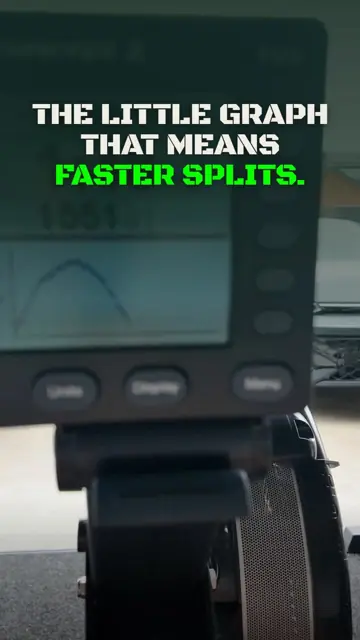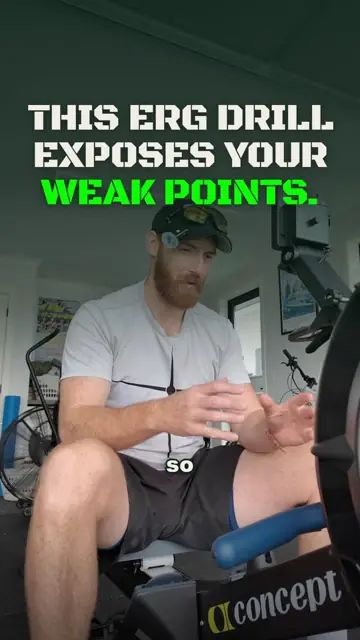
I don't stare at my split on the erg. I stare at the little graph underneath it. That graph is your force curve, and it's the most useful thing on the monitor once you know how to read it.
How to set up the force curve on a Concept2
When I'm on a Concept2, I always set the bottom half of the screen up as the graph showing the force curve, and the top half as either the split or the wattage.
On a PM5, press Display until the force curve fills the bottom half of the screen, then use Units to set the top half to split or watts. Concept2 says the Force Curve is on PM3 and PM4 monitors too, using Display or Change Display, or the second button down on the right of the monitor.
The way Concept2 does it, the line is drawn as you take the stroke. You watch each drive build from the catch to the finish in real time, which is why it's such a good feedback tool. Concept2 describes it as your power application on the up axis over time along the bottom.
What does a good force curve look like in rowing?
The best force curve is a smooth, symmetrical bell curve. You want it to be a totally smooth upside-down U.
"I just stare at that little graph see how much of a symmetrical bell curve I can create."
Then I try to make that curve as consistent and smooth as possible. Consistent matters as much as smooth. One beautiful stroke followed by a lumpy one isn't the goal. You're after the same full shape every stroke, at whatever rate and split the session asks for. When I filmed this one I took a few different pieces at different splits and a slightly different rate. The numbers on top changed, but the bell curve underneath still looked pretty good.
Why a smooth force curve means faster splits
"Often a really good curve will mean faster splits, not often, always."
A really full bell-shaped curve means more watts and faster splits, consistently. That's why I watch the graph more than the numbers.
Concept2 makes the same point. It says dips in the curve reflect a lack of continuity in power, that you want to apply consistent power to maximise your speed, and that each dip costs some tenths of a second per stroke, which add up.
Rowing force curve analysis: dips, humps and spikes
A dip, a hump or a spike means the power's coming on in bits instead of one smooth push.
Concept2 explains the bell shape like this: the legs are the biggest, strongest muscles and build the peak, then the back and arms take over and bring the curve back down to finish the stroke. It says the most common blip is the handover between the legs and the back, and that the curve drops away the longer you spend on your layback. So if your curve has a dent partway through, look at that handover first.
One drill I like for feeling that handover is legs-only rowing, body forward. You sit at the catch, drive the legs down and complete, then bring the body in for legs and body. I do 20 strokes legs only, then 20 strokes legs and body, then normal rowing, and repeat that twice so it adds up to 120 strokes. It splits the stroke into its pieces so you can feel where the power hands over. Getting the power from the legs to the handle without it leaking out is the other half of this, and that's in hang off your lats.
A tip for watching it
The screen can be a bit flickery, which makes it hard to see the shape on any single stroke. Don't chase one stroke. Watch a run of them and look for the shape they keep making.
Concept2's founder, Peter Dreissigacker, is quoted on the same page saying that even rowers with good technique can improve by doing rows where they watch the Force Curve with a low damper setting. If you want to know what drag to train at the rest of the time, I've covered drag factor and damper settings.
Not every great rower's curve looks the same
Hamish Bond is the best example I know of someone who sends the boat backwards instead of sideways. His force curve is front-ended. He locks on at the catch, gets a wall of power off the leg drive, then stays relaxed through the finish. I wrote about him in what is the best rowing technique. On the erg, my own cue stays simple: one smooth bell, every stroke.
Where this fits
The force curve is one of the things I watch on every stroke, but it sits on top of doing the training and backing yourself. That bigger picture is in how to row faster on a rowing machine. If you've got a 2k coming up, the sessions I used to build my confidence are in the free PREP download. For more on erg sessions and tests, start at the erg and testing topic page.
Send this to a Meataxe who needs to hear it.
Sources: Improving Your Rows with the Force Curve (Concept2)