Drew Ginn asked me on Mercantile Radio whether we even did drills in the Kiwi eight. Fair question. The classic Meataxe assumption is that drilling is stupid and isn't going to make any difference. Why are we pausing around the finish? I used to be one of them. I'm an enlightened Meataxe now, so I've been on the other end of it.
Do rowing drills make a difference?
They do, and I mean that in pragmatic, simple rowing terms. Having a really good set of drills on the water changes how well the crew rows together and how well you row in that crew. A drill takes one part of the stroke and makes everyone do it the same way at the same time.
"it's almost like the fact you're doing it when you're tired is kind of forcing your body to start to move together"
So don't save drills for when you're fresh. Drew called all this Meataxe artistry. We agreed to disagree on that one.
"The faux pas of a Meataxe is to discredit the value of those drills."
The drill with no oars
Tony O'Connor would throw out some crazy ones. We'd be in the eight with six guys rowing, and the other two guys wouldn't have oars. They'd move up and down the slide with the six other guys anyway.
"you would literally not have an oar and act like you've got an oar, but you would let your body just move with the momentum of the six other guys"
With no oar in your hands, all that's left is the boat. You start to feel where it is. More of what Tony taught us is in what I learnt from Tony O'Connor.
Rowing drills for balance
If the crew is struggling for balance, the gunnel tap and the pausing exercises can be really beneficial.
- Gunnel taps. A light tap as your blade clears your knees, with the whole crew tapping the gunnel together. Do 10 strokes on, 10 strokes off, about 3 or 4 times through. They're one of the three drills we kept coming back to in the Kiwi eight.
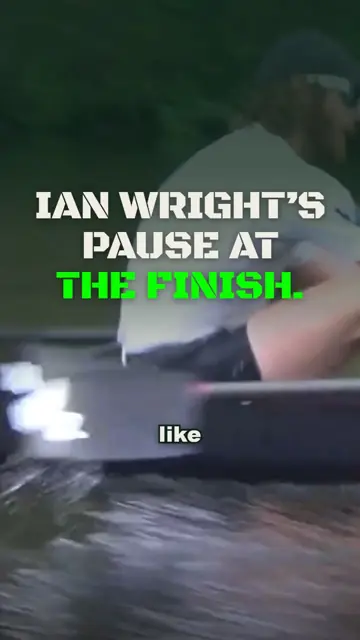
- Pauses. Pause at the finish with the blade dropped down, and find that height together at the drop-out point. Then try pausing hands away, body over and quarter slide. You can pause at each point in one stroke, or choose one and do it for 10. Pauses are a good timing drill coming into race season, and Ian Wright's pause at the finish is where I learnt it.
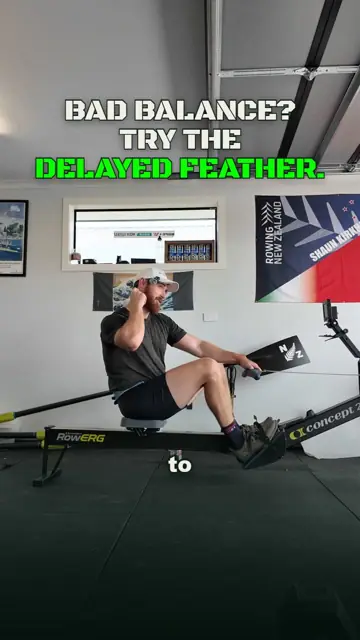
- Delayed feather. Pull the blade out square, let it feather, then row normally. I've written up the delayed feather drill on its own.
Balance is often just timing issues, which is why most balance drills are really about everyone doing one thing at one moment.
Rowing drills for catch timing
If the crew is struggling for catch timing, the build off the front is the key one. The full crew does it on the square blade, in this order:
- Bobbing at the catch, where the blade enters and exits together at the front stop
- Front quarter of the slide
- Front half of the slide
- Full legs
- Legs and body
- Full strokes
Do 10 or so at each length until the boat's settled, then move on to the next one.
"That build off the front is a really key core exercise for any boat and for any rower to get really skillful at the catch."
It's a good one to practise at the start of each session. Do it again at a turnaround point, halfway through, to bring everyone back together on the catch.
Catch slaps are the other one for catch timing. Roll up with a feathered blade, slap it in as hard as you can, then go back to normal rowing and feel how light the catch is.
Rowing drills for rhythm
If the crew is struggling with rhythm, low-pressure starts are a really good one. Go through the full race start together, 10 strokes, with no pressure, and think about how easy you can make it feel. Your rating will be down because your pressure is down, and that's totally fine. Often you'll build a surprising amount of speed.
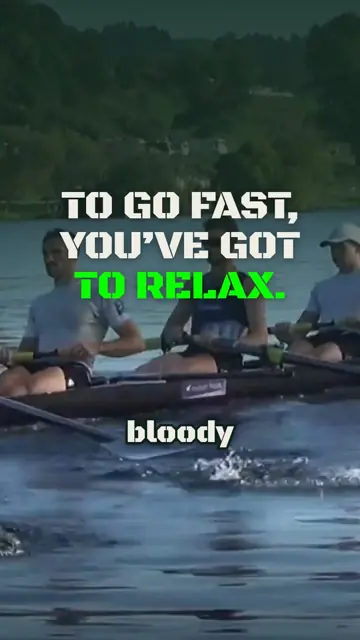
Eyes-closed rowing is another great one for rhythm: the full crew, 20 strokes on, 20 strokes off. Both drills are about relaxing, and there's more on that in how to relax when rowing.
A drill for locking on together
If the crew is struggling with locking on together, back the boat. Reverse it at full slide. As you get to the front with your blades buried, let the blades grip at your catch position, then take a stroke. You're sending the boat backwards, gripping the water and propelling it forward again.
"Just do one stroke over and over again to feel how much lock and leverage you can create."
It teaches you how to lock onto the water and lock all those muscles together, and it's good for rhythm too.
Which drill does your crew need?
Work out what the boat is struggling with first, then pick one or two drills for it. Don't run through the whole list every session. The rest of my rowing technique articles go deeper on the catch and the finish, and the Top Drills download has all of these on one page to take to the boat park.
More from Shaun on this
Read the transcript
These three exercises were some of the foundational exercises we did as part of the Kiwi Men's Eight that went on to win the Tokyo Olympics. We would do these exercises almost every training, the first being gunnel taps. So we would actually tap our gunnels with our blades to really exaggerate the clearance off the water, to make sure our blades weren't hitting our own puddles, to make sure we're tapping out to the same point. The second one would be catch slaps. Catch slaps were so fucking crucial for an eight, particularly an eight. That helps so much with that decisiveness that you need to get on the catch on such a fast moving boat. And especially powerful when you do a set of catch slaps right before some race pace. And the final one we do is just a simple quarter slide pause. Just getting everyone to that same point together at the same time so that we could roll up to the catch with a bit of confidence. Those were the Kiwi Eight's go-to exercises.
Read the transcript
Hello Medaxes. So a really good exercise to do to help with the balance on your boat is the delayed feather. So what that is is you come through to the finish, you drop down together and then you feather. You wait a moment before you feather the blade and you get the whole crew doing this and you'll see that everyone comes out square and then feathers. But yeah what you'll notice with that exercise when everyone does it together is it creates this very clear like dropout point. Because often when we've got unbalanced boat we're having this like little bit of feathering before the blade is out of the water so the water's here and you start feathering there and you're actually like picking up water on your blade and pushing on it which drags it down to your side and by coming out square and then feathering on this exaggerated drill you eliminate that problem and it can like expose whether that's the thing that's causing your bad balance. So send us some edX needs to hear it.
Read the transcript
Hello Meataxe. So this is what it was like to be coached by Ian Wright. Now if you don't know Ian Wright, Ian Wright is the guy who kind of really introduced the exaggerated time around the finish. That's his style, he probably took what Drew Ginn was talking about, their famous Australian rower, and dialled it up to 11 basically, to the point where we were fully pausing around the finish and then flowing away, especially at the lower rate. Spending time around the finish and being quite swifter to the front can make a boat go pretty fast, but the thing that makes or breaks it is whether everyone in the crew buys into it and does it all together. And I think that's what having a lot of time around the finish and even pausing does, is it brings the entire crew together at one point, which is, you know, one of the hardest things to do in rowing, to row in time. And this technique makes it easier to row in time because it is so black and white, you know. And there's so many haters out there of that style, but fuck, I won two World Championships rowing like that, so it does work, you can win when you row like that. Ian Wright then took that style and hit copy and paste and brought it over to the Swiss national team and they won Olympic gold, and then the same with the Australians and they won Olympic gold. Why didn't he just stay in New Zealand is what we all wondered.