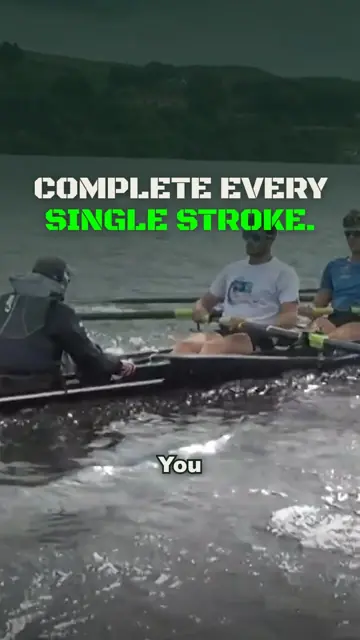
I got asked how to improve catch slip, and it's a good question, because it's one of the few technical things that shows up straight away in boat speed. We had a simple picture for it in the New Zealand rowing team, and it still works on me now.
What is catch slip in rowing?
"it's basically when you put the blade in the water, how long or how much slippage is there before the blade is fully locked on and actually moving the boat"
We want that slippage as low as possible, so the moment the blade is in the water it's moving the boat forward. Every bit of slip is part of the stroke where you're working and the boat isn't going anywhere.
The glass pole: how we placed the blade in the Kiwi eight
Imagine a glass pole sticking out of the water right where your blade goes in. It goes down two metres into the water and sticks up out of it about five centimetres. As the blade comes in at the front, you're trying to hook it in behind that pole.
"we're trying to hook the blade around that glass pole and gather it and accelerate it on without smashing it into a million pieces"
That picture does a few jobs at once. It makes you place the blade accurately, because you're aiming for something. It makes you place it smoothly, because if you crash in you'd smash the glass. And once you've hooked it, you collect the water and lever the boat forward instead of tearing through it.
Impulse off the front
The glass pole is about where the blade goes. The other half is what your body does the instant it's in. In the Kiwi eight we used to talk about impulse off the front: how quickly you turn around at the front of the stroke and apply effective power.
Kicking the legs down and throwing your body back is the easy bit. This is the bit that takes practice:
"the hard part is getting to the front and immediately switching your legs on and holding that pressure through your whole body without any slippage"
That immediate connection is what levers the boat past the pin. If your legs come on late, or your body gives way as the pressure arrives, the blade slips and you lose the start of the stroke. The setup before that moment matters too, and I've written about getting to the front ready in how to get a quick catch in rowing.
How to practise it on the erg
Watch your force curve. The erg is a good place to work on this because you can literally see it.
"a good impulse off the front is when the curve is like to the left, it's building steep in a nice bell-shaped manner"
That steep, early build is the erg showing you the blade locked on with no slip. There's more on reading the shape in reading your force curve.
Drop the resistance right down to one and try to hold your usual splits. With so little load, you can't muscle it. Your legs have to fire faster and you have to be more coordinated at the front, and for a big Meataxe it's a good way to learn to get on quickly and control your body weight. Set it back to normal for your training after; drag factor and damper settings covers what I'd use day to day.
Feel how locked on you are. The erg tie-down drill shows you straight away if you're connected at the catch or slipping into it.
Common mistakes
Smashing the blade in. If you crash in, you'd smash the glass pole into a million pieces. Hook in behind it, then accelerate.
Thinking a big finish makes up for it. There's no speed in being rough and loud at the finish. You can only finish with the arms what's been created with the legs at the front.
Rowing your own catch. In a crew boat, a clean catch is a clean catch together. Getting the blade in on your own timing slips the boat for everyone else.
There's more on the basics in rowing technique, and the drills we kept coming back to are in three drills from the Kiwi eight.
More from Shaun on this
Read the transcript
hello you tasty little Meataxes the most important part of the stroke is the catch like getting the blade in cleanly with the rest of the crew and applying smooth power immediately and in the kiwi 8 we used to talk about impulse off the front that is how quickly you turn around at the front end of the stroke and apply effective power because it's and immediately switching your legs on and holding that pressure through your whole body without any slippage. And I think rowing on the erg is such a good way to practice that impulse off the front. I mean you can literally see your force curve and a good impulse off the front is when the curve is like to the left, it's building steep in a nice bell-shaped manner. In other exercises you can do, slam that resistance down to one and hold your usual splits. You'll realize your legs need a fire, you need to be more coordinated. So send this to a med-ex, who needs to hear it?