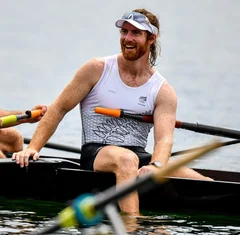
People ask me how long it takes to get good at rowing. My honest answer is longer than you'd like, and never in a straight line. Here's my own timeline, from a 7:04 2k at 14 to the Olympic final in Tokyo, so you can see what it really looked like.
How long does it take to get good at rowing?
For me it took from age 14 to 29, and the progress came in two very different stages.
The first stage was fast. A full minute came off my 2k in the first five years. After that it was a grind for seconds, sitting between 5:45 and 5:51 for the best part of seven years. Then at 29 it was Tokyo.
Here's every 2k erg score I pulled from 14 to 28:
| Age | 2k erg |
|---|---|
| 14 | 7:04 |
| 15 | 6:50 |
| 16 | 6:33 |
| 17 | 6:19 |
| 18 | 6:16 |
| 19 | 6:04 |
| 20 | 5:59 |
| 21 | 5:54 |
| 22 | 5:50 |
| 23 | 5:51 |
| 24 | 5:45 |
| 25 | 5:46 |
| 27 | 5:45 |
| 28 | 5:46 |
I go through these scores in more detail in my 2k erg scores by age.
The early years: big gains
I was in the New Zealand junior team in 2009 and 2010, then moved up into the under-23 team in 2012. My first real success was the 2013 and 2014 under-23 world champs, where we won the men's eight back to back.
Coming into the under-23 team and then the elite team, I was making big gains over and over again. It was exciting. I was knocking seconds off my 2k left, right and centre, and I was getting faster and faster.
Then the ceiling
"One thing I really struggle with in the sport of rowing is the fact that your progress isn't linear."
Then it just stopped. I kept hitting that ceiling for about four years. I got stuck there and I got really disheartened that there wasn't a straight line where I just kept on getting better and better.
I reckon there's a sticking point in a lot of athletes' careers. It isn't at the same time for everyone, but if you stick at the sport long enough, you're probably going to reach it. The improvements at that point get so small that you don't even recognise them. Then other things start happening. I started getting quite negative about my progress, which made my progress slow down even more. You might still be getting better, but something else, like your head, is what's actually holding you back.
My results were all over the show
My crew results followed the same kind of path. We kept that under-23 eight together through 2015, finished fourth at the 2015 world champs and qualified for the Rio Olympics, which was a huge achievement for such a young crew. Then we went to Rio and bombed pretty hard. We finished sixth, last in the A final.
In 2017 we finished sixth again. In 2018, with another new crew, the men's eight finished dead last. In 2019 Hamish Bond and Mahé Drysdale came into the crew and we thought that would fix all our problems. It didn't. We failed to qualify for the Tokyo Olympics. I tell that story in two Olympic champions joined our eight and it didn't solve everything.
It was the boat class I loved, so I stayed in it as best I could. In 2020 COVID hit and we found ourselves in lockdown in New Zealand, training in a garage for an event we didn't even know would take place. We managed to qualify, and then we won the Olympic final in Tokyo.
In 2018, when we were the slowest eight in the world, if you had told me we'd win the Olympics a few years later, I'd have laughed my head off.
Being gifted isn't the point
"I was never the most gifted athlete but in this sport you don't have to be gifted to have success"
That's what I love about rowing. One thing I'm most proud of is my resilience through the years that were really hard. If you're a big, strong rower who isn't a natural, that's good news. It's what a Meataxe rower is all about.
What to do while you wait for the progress
Rowing is a pretty simple sport, and when you're in the thick of it you'll do your best to overcomplicate it, especially if you're an overthinker like me. What we used to say in the Kiwi eight was just to trust the process. You will start to get the results, but you have to be patient.
"Trust that what you're doing right now, the hard work that you're putting in, if you stick to it, if you stay as positive as you possibly can, day in, day out, and just keep on turning up, that you will get the progress you are looking for."
So if you've hit your own ceiling, don't panic. It's part of the game. Keep your basics sharp with how to row properly, work on your head with what Mahé Drysdale taught me about self-belief, and find more on the training page.
More from Shaun on this
Read the transcript
One thing I really struggle with in the sport of rowing is the fact that your progress isn't linear. I found early on in my career, when I was coming into the under-23 team for New Zealand and then moving into the elite team for New Zealand, I was knocking seconds off my 2k left, right and centre. I was getting faster and faster. And then I just had a ceiling. And I kept hitting that ceiling for four years. Like I just got stuck and I wish I knew earlier that that's just fucking normal. That's just like part of this game, and often the improvements at that point are getting so small that like you don't even recognise them, and then other things start happening like you start getting, for me, I started getting quite negative about my progression, which then made my progression slow down even more. But one thing that we used to say in the Kiwi eight is just to trust the fucking process. Just trust the process. Trust that what you're doing right now, the hard work that you're putting in, if you stick to it, if you stay as positive as you possibly can, day in, day out, and just keep on turning up, that you will get the progress you are looking for. But you have to be patient. So send this to a Meataxe who needs to hear it.